

Read the Rules Carefully: A Lesson from the Agility Race in eISR 2022
During the European International Submarine Races 2022, our team learned an important lesson that applies not only to competitions but also to engineering projects in general: understanding the rules can be just as important as technical performance. In many competitions, it is easy to assume that speed is the deciding factor. This was also the first impression during the agility race, where team after team completed the slalom course at an impressive pace. Compared to many competitors, our submarine Rivershark was not among the fastest. Nevertheless, after our first attempt, we found ourselves in a surprisingly solid position in the midfield.
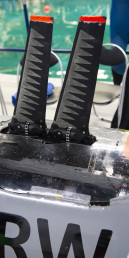
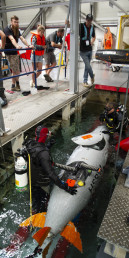
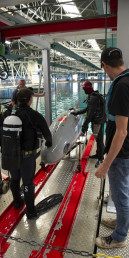
By watching the scoreboard more closely, it quickly became clear why. While other teams often achieved faster times, many also collected penalty points by surfacing, missing gates, or making other course violations. Since penalties had a much greater impact on the final score than small time differences, the ranking was determined less by speed and more by consistency. At that point, no team had yet completed the course without faults. This observation completely changed our strategy for the second run. Rather than trying to push for a faster time, our goal became simple: complete one clean run.
As a pilot, I was already familiar with Rivershark’s handling characteristics. The submarine performed reliably at low speeds, but became increasingly difficult to control when moving faster. This made the strategy straightforward, even if not particularly exciting from a racing perspective: stay calm, maintain control, and move steadily through the course. The first lap went smoothly, and by the second lap, the main challenge became mental rather than technical. It was surprisingly difficult to resist the instinct to accelerate as the finish line came closer. In the final slalom section, I slightly overcorrected while adjusting depth, causing the submarine to tilt as air shifted toward the tail. From inside the submarine, visibility was too limited to determine whether any part had briefly surfaced, so I could only stabilise the submarine, continue, and wait for the final result.
After crossing the finish line and surfacing, the uncertainty remained until the race director announced, “Rivershark with a perfect run – zero faults.” Our team had completed the only faultless run of the agility race, securing first place in the discipline. The points gained from this result ultimately also contributed to winning the overall competition trophy. Looking back, this experience highlighted a lesson that is highly relevant in engineering: success is not always about pushing harder or moving faster. Sometimes, the best strategy begins with carefully understanding the requirements before taking action.
So yes, in this case, slow and steady really did win the race.
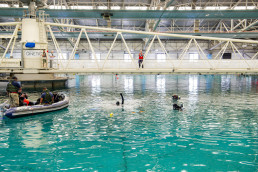
Victory sign
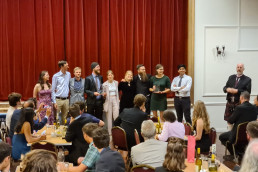
Award Ceremony – World Champion
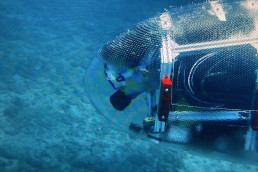
Chelonia at the Gran Canaria Invitational (2023)
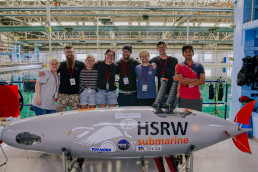
HSRW Team 2022
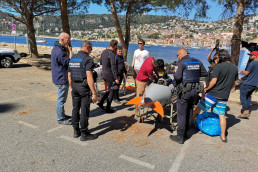
Rivershark getting a police inspection in Villefranche, France (2019)
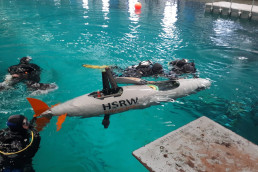
Rivershark at eISR 2018
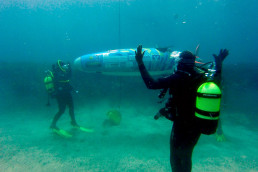
Rivershark in the Ocean at Villefranche, France (2018)
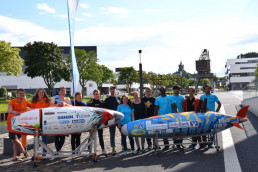
HSRW vs. WASUB revenge match in Kleve (2017)
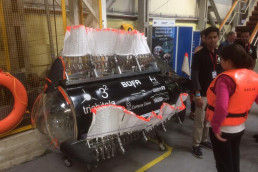
Trichitala at eISR 2016

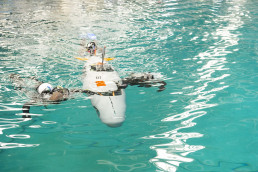
From RiverShark to RhineRay: Continuing the Submarine Legacy at Rhine-Waal
For many students at Rhine-Waal University of Applied Sciences (HSRW) in Kleve, Germany, the European International Submarine Races are more than just a competition. Over the years, several student teams have taken on the challenge of designing and building human-powered submarines, gaining practical experience that goes far beyond the classroom. Earlier projects from the university carried the name RiverShark, inspired by Kleve’s strong connection to water and the historic canal that runs through the city. Those teams laid the groundwork for what has become a small but proud tradition.
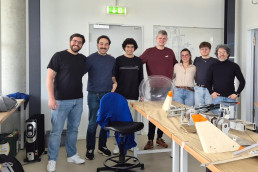
HSRW Team 2026

Sketch of the RhineRay (2026)
A distinctive aspect of the submarines developed at HSRW has always been the combination of traditional engineering with biomimetic inspiration during both the design and development phases. When our new team began to form, we spent time looking back at the experiences and participation of previous groups. Their work helped us understand not only the technical challenges involved but also the creative thinking that has always been part of these projects.
At the same time, several members of the current team share a strong interest in biomimetics and the mechanics of animal movement. During early discussions, the idea emerged to take inspiration from the smooth and efficient swimming motion of manta rays. From this concept, the name RhineRay was born, combining a reference to the Rhine region with the biological inspiration behind the design. In many ways, it represents both a continuation of earlier ideas and a fresh direction for the team.
Like the university itself, the team is highly international, bringing together students from different countries and study programs. Engineers, sustainability students, and business students all contribute their perspectives as the project develops. While the technical work is only beginning, the collaborative spirit within the team already reflects what makes the submarine races so special: creativity, curiosity, and the chance to work together on something truly ambitious.
Gallery
Chelonia at the Gran Canaria Invitational (2023)
HSRW Team 2022
Rivershark getting a police inspection in Villefranche, France (2019)
Rivershark at eISR 2018
Rivershark in the Ocean at Villefranche, France (2018)
HSRW vs. WASUB revenge match in Kleve (2017)