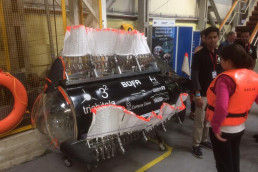
During the European International Submarine Races 2022, our team learned an important lesson that applies not only to competitions but also to engineering projects in general: understanding the rules can be just as important as technical performance. In many competitions, it is easy to assume that speed is the deciding factor. This was also the first impression during the agility race, where team after team completed the slalom course at an impressive pace. Compared to many competitors, our submarine Rivershark was not among the fastest. Nevertheless, after our first attempt, we found ourselves in a surprisingly solid position in the midfield.
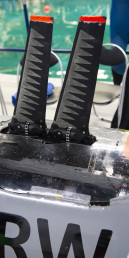
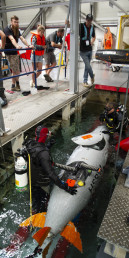
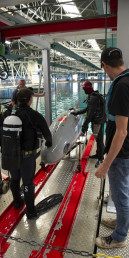
By watching the scoreboard more closely, it quickly became clear why. While other teams often achieved faster times, many also collected penalty points by surfacing, missing gates, or making other course violations. Since penalties had a much greater impact on the final score than small time differences, the ranking was determined less by speed and more by consistency. At that point, no team had yet completed the course without faults. This observation completely changed our strategy for the second run. Rather than trying to push for a faster time, our goal became simple: complete one clean run.
As a pilot, I was already familiar with Rivershark’s handling characteristics. The submarine performed reliably at low speeds, but became increasingly difficult to control when moving faster. This made the strategy straightforward, even if not particularly exciting from a racing perspective: stay calm, maintain control, and move steadily through the course. The first lap went smoothly, and by the second lap, the main challenge became mental rather than technical. It was surprisingly difficult to resist the instinct to accelerate as the finish line came closer. In the final slalom section, I slightly overcorrected while adjusting depth, causing the submarine to tilt as air shifted toward the tail. From inside the submarine, visibility was too limited to determine whether any part had briefly surfaced, so I could only stabilise the submarine, continue, and wait for the final result.
After crossing the finish line and surfacing, the uncertainty remained until the race director announced, “Rivershark with a perfect run – zero faults.” Our team had completed the only faultless run of the agility race, securing first place in the discipline. The points gained from this result ultimately also contributed to winning the overall competition trophy. Looking back, this experience highlighted a lesson that is highly relevant in engineering: success is not always about pushing harder or moving faster. Sometimes, the best strategy begins with carefully understanding the requirements before taking action.
So yes, in this case, slow and steady really did win the race.
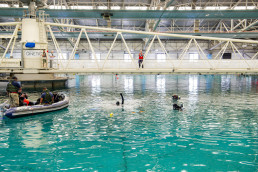
Victory sign
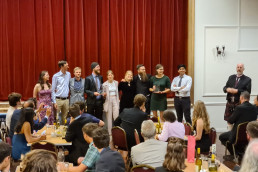
Award Ceremony – World Champion
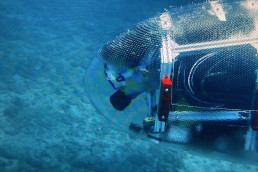
Chelonia at the Gran Canaria Invitational (2023)
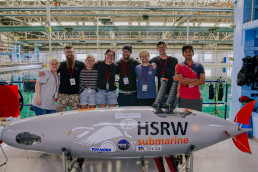
HSRW Team 2022

Rivershark getting a police inspection in Villefranche, France (2019)
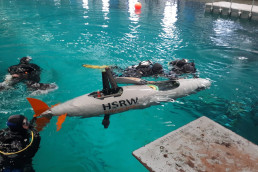
Rivershark at eISR 2018
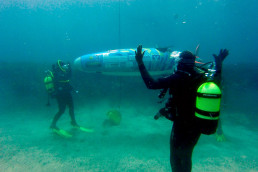
Rivershark in the Ocean at Villefranche, France (2018)
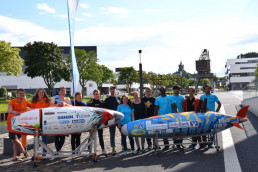
HSRW vs. WASUB revenge match in Kleve (2017)