

Meet Claire Machin: Engage Principal Consultant and eISR 2026 Judge
Cross-posted from here.
Engage Technical Solutions Ltd is proud to be a Gold Sponsor of the European International Submarine Races (eISR) 2026, and even prouder that our own Claire Machin, Principal Consultant, will support the event as a judge. Taking place in Gosport, from 29th June – 10th July 2026, eISR brings together innovative student teams to design, build and race human-powered submarines.
Why this event matters
eISR brings engineering to life, showing how ideas translate into real-world solutions through hands-on innovation. It highlights teamsworking together to solve complex problems and perform under pressure, reflecting the environments our own people operate in.
At Engage, our work across engineering, digital programme delivery and technical consulting relies on the same foundations: collaboration, critical thinking and delivering results in high assurance settings. As an employee-owned business, we value shared success, accountability and continuous improvement, making this event a natural fit.
Spotlight on Claire Machin
Claire is a Principal Consultant at Engage, specialising in complex engineering and technical project delivery. She brings experience in design, development engineering, test oversight, safety and compliance, as well as maritime leadership. This year, Claire joins the judging panel alongside naval architects, submarine engineers and experienced pilots. Together, they review the student-designed human-powered submarines for safety, design and performance. We asked Claire to share more about the event, her role as a judge and what makes eISR such a unique engineering challenge.
Q – For anyone new to eISR, what makes this event so special?
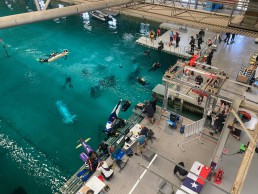
CM – It is a unique challenge, because the teams are designing a submarine so there are a lot of things to consider. The hull form needs to be designed to house the pilot, allow movement, include mechanisms for propulsion and steering, and be as aerodynamic as possible so the boat moves efficiently through the water. They also need to control the boat as it moves forward, keep it submerged and steer it through the tank and slalom section.
In addition, you have a human pilot in the water on scuba gear so there are many life support factors to consider, including escape or calling for help if anything goes wrong. It is the ultimate challenge.
The teams decide the propulsion method, how power is generated, how the boat will steer and how to keep it level in the water column. There is a wide variety of options and categories for propeller and non-propeller boats. Some teams choose bio-mimetic options, others have electrical systems for depth control. There is a lot of innovation in both design and build. We have had traditionally built wooden boats and others which have been 3D printed. Teams decide what is possible based on the resources they have.
During the competition the size and make-up of teams varies. Some have pilots who are not on an engineering path but are the right size and fitness for the boat. They work with the team to refine fit, handling and escape. It’s a bit like a professional driver working with a race team.
There is also a lot of collaboration between teams during the competition. It can be hard to bring enough people or equipment due to cost. Teams loan divers and equipment to each other. It reflects a strong maritime spirit where everyone is in the same position and helps where they can.
Q – What makes human-powered submarine racing such a fascinating engineering challenge?
CM – There are so many challenges, you have the environment which does not support life without equipment, you have pressure because you are underwater, you are also trying to move through the water. There are corrosion problems because of the water, so material selection is important. Your engine is also your pilot and you need to consider how to transfer as much power as possible from them to the propulsion system. You also need to move forwards, backwards at times, and from side to side while staying submerged. It is complicated, it is the ultimate engineering challenge.
Q – What does your role as a judge involve at eISR 2026?
CM – As judges our main role is to ensure that the rules are upheld and everyone is treated fairly. The teams submit a variety of documents, all the diving related documents go to the dive supervisor, and all the design documents go to the judges. As we often have more teams than places the documentation submission can often be the deciding factor. The teams need to produce specifications, videos of the boats in action, and a design report all of which are reviewed and marked by the judges. These marks go towards the final score so its not just about boat performance during the race.
Pre-race, the judges review each boat to check it passes a dry inspection. Once complete they can put their boats in the water and then pass the wet test before they qualify to race.
During the races the judges monitor the boats on the course, they track the boats path and mark any deviations or penalties incurred. There are penalties for things like, broaching, hitting markers, dragging markers etc. They also do an independent time check of the race.
Q – How does your own background help you when judging an event like this?
CM – My background is in design and manufacturing, which includes test and commissioning, so I know what it takes to go from a blank sheet of paper to a finished product that you test and what to do when it doesn’t quite work how you envisioned.
Having worked with life support systems in the past I can appreciate the challenges the teams face. There are so many facets to producing a design where you need to qualify and justify each decision, ensuring the safety of the teams and the pilots is paramount.
My previous experience as a lecturer helps as well when it comes to marking the reports and assessing the build quality and manufacturing challenges the teams face. I have also dived a little in the past and that gives me an understanding of what it is like to be underwater trying to perform tasks.
Q – What do events like eISR tell you about the next generation of engineers?
CM – I have been a judge for the eISR for many years and the team’s ingenuity and enthusiasm is always a privilege to experience. The teams have some great ideas, and they are willing to try new things and innovate. The teamwork that an event like this fosters is great, teams often have groups who are dedicated to a system or support systems, and they all need to work together and communicate to get results. Skills like this will be so important in their future careers, and for the non-engineers who support,they get valuable experience as well, from project management, procurement, marketing, and the variety of backgrounds the pilots come from they demonstrate an amazing variety of skill and experience they can lean on in the future.
Q – Why do you think industry support and sponsorship matter for events like this?
CM – Without industry partners this event would not happen. QinetiQ have an amazing facility and to allow the teams access for 2weeks is fundamental to the event, there are very few places in the world that have resources like Haslar, we are very lucky to have a test facility like this in the UK and have access. Industry support means we can fund the event in terms of people and financially, many of the judges and support team are released from their workplace, at significant cost, to attend. It also gives the teams an opportunity to talk to people from industry not just the judges and support staff but the sponsors who attend. As a student it can be difficult to find the people who do what you want to do and ask them questions, to get that unique insight into what companies do daily, the kinds of projects that are out there and the skills they are looking for.
The financial support is critical for the event to run, but there is huge value in the conversations that the sponsors have with the teams, and the experience the teams have will be with them for the rest of their lives.
Where possible we try to host events at places that would interest the students, in the past we have had speakers delivering talks on maritime topics, and local school children coming in and talking to the teams, the inspiration goes in all directions!
Supporting Future Engineering Talent
At Engage, we are proud to support events like eISR, which play a vital role in showcasing the talent, creativity and determination of the next generation of engineers. As a Gold Sponsor, we see first-hand the impact these experiences have in developing technical capability, confidence and collaboration in a real-world environment.
Beyond the engineering challenge itself, it is the teamwork and support between the teams that really stands out. Events like eISR give students the opportunity to gain hands-on experience, solve complex problems and develop skills they will carry with them throughout their careers.
We look forward to following their progress and are proud to support the talent shaping the future of engineering.
Original news release from Engage: https://www.engage-ltd.co.uk/news/meet-claire-machin-engage-principal-consultant-and-eisr-2026-judge



eISR 2024
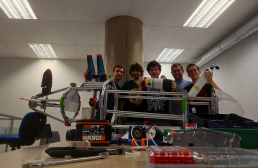
The 6th edition of the European International Submarine Races was held between June 24th and July 5th 2024 at QinetiQ’s Ocean Basin facility at Haslar in Gosport, UK. Eleven student teams from Canada, USA, UK, Germany, Singapore and Taiwan took part in two weeks of exciting submarine racing! Overall winners were Omer ÉTS with their 3D-printed submarine Omer 13. Runners-up were Florida Atlantic with Owlbacore. The eISR 2024 saw the debut of the Nautical Knights from the Singapore Institute of Technology, who secured fourth place with their submarine Mako.
The Teams

Winners
University: École de Technologie Supérieure Montréal
Team: Omer
Submarine: Omer XIII
Fastest speed at eISR 2024: 5.29 kt
- 2018: World speed record non-propeller
- 2018, 2014 and 2012: Overall winners
- 2016: Innovation Award
Runners-Up
University: Florida Atlantic University
Team: FAU
Submarine: Owlbacore
Fastest speed at eISR 2024: 4.53 kt
- 2018: Innovation Award
- 2012: Runners-Up

Stories from eISR 2024
The eISR 2024 got off to a quick start! On Monday, June 24th, the race and QinetiQ staff began preparing the racecourse, cameras and timing station. The teams were allowed on site on Tuesday and began unpacking their crates. After diver checks and scrutineering by the judges and the Army, the first wet checks began on Thursday. UWHPS’s Orca was the first submarine in the water, just as it was during the eISR 2022.
In a new eISR record, the racecourse and a majority of the teams were ready to race by the end of Thursday! Kudos go to FAU, who were ready to go even though Owlbacore only showed up at QinetiQ three days into the race. The race staff and judges decided to make use of this unexpected extra day and allowed exhibition racing on Friday morning. On Day 0 of the races, FAU, UVIC and Omer all managed to post zero-fault runs, setting the stage for an exciting competition. The biggest spectacle of the day, however, was the rapid unscheduled disassembly of NCKU’s 3D-printed propeller mere metres from the finishing line. Nevertheless, with no propulsion left, the pilot expertly managed to use the submarine’s inertia to guide the submarine through the finish line!


Racing officially began on Monday, July 1st. NCKU, with a fresh new propeller that they designed and printed over the weekend, posted the first official time of the competition, quickly followed by FAU, Omer and UVIC. All three teams clocked speeds above 3 kts, faster than any team has posted at the European and American races since COVID. HSRW and newcomers SIT got off to a good start as well, posting their first times in the afternoon heat. At the end of Day 1, in terms of speed Omer XIII was ahead with 4.92 kts, followed closely by an ever-faster Owlbacore with 3.84 kts and UVIC’s Sockeye II with 3.29 kts. Monday also saw the release of the new eISR website and live scoreboard, which the race staff had been finalising over the weekend.
July 1st was also Canada Day! The four Canadian teams pulled out all of the stops and worked together with the chef at the Kingfisher Caravan Park to make poutine for everyone. For those unfamiliar with the concept, poutine is a dish of french fries and cheese curds topped with brown gray which originated from Québec. The result was very good, especially considering the lack of proper Canadian ingredients, although members of the Omer team have since promised a more traditional experience for anyone who visits Montréal…! Not to be outdone, on July 4th the American teams organised burgers, hot dogs and a party on the beach.

On Tuesday, the slalom poles were moved closer, presenting the teams with an increased challenge. Owlbacore and Pegasus set times in the morning heat; in the afternoon, Sockeye II, Omer XIII and Mako were joined by UWHPS’s Orca, who completed their first run with a speed of 1.51 kts. Omer had a very strong afternoon, posting first 5.16 kts and then both the fastest speed and course time of the eISR 2024: 5.29 kts and 1:12.5 min, only 8 seconds slower than the course time record set by WASUB VIII in 2018! Eight teams were now in the running for the eISR title. Warwick and Archimède continued to struggle with directional control and buoyancy but were making progress; Michigan broke a significant part of their steering system; and UBC were working hard to get Beagle operational.
The slalom got significantly more challenging on Wednesday, as the poles were now placed in line with one another. The morning heat pitted Pegasus, Archimède IX, Mako and Omer XIII against one another. Pegasus set two zero-fault runs and was proving to be a very reliable submarine; Mako continued to gain speed, setting a time of 2.48 kts; and Omer nearly topped their fastest speed from the previous day, coming in at 5.24 kts. Archimède IX also managed to set a speed through the timing gates, even if their submarine aborted the run in the far corner of the tank. Owlbacore started off the afternoon heat, followed by Orca, Warwick’s Godiva, Sockeye II, Chelonia and even Beagle. As with all long submarines that attempt the eISR course, the slalom proved a big challenge for Owlbacore, but the pilot did an excellent job, even setting a zero-fault time. The remaining afternoon subs struggled: Except for Owlbacore, only Sockeye II made it around the course on their final attempt. In the last run of the day, however, Godiva crossed the finish line for their first successful run at the eISR 2024. We now had nine teams in the running!

On Tuesday July 2nd, QinetiQ hosted the next edition of the prestigious IMarEST Stanley Grey Lecture Series. After an unfortunate illness by the planned speaker, race director Prof. William Megill stepped in to give a talk entitled “Swims Like a Fish” about fish biomimetics.
Afterwards, representatives of QinetiQ handed the SIT team two flasks of “Froude Water”. This water will be used in a Mixing of the Waters ceremony at their tank facilities in Singapore. This traditional ceremony goes back to the very first towing tanks in the world, including the one at Haslar (opened in 1886), which were opened and run by William Froude and his son Eddie. The ceremony symbolically links towing tanks all over the world to one another, emphasising the importance of collaboration and cooperation within the maritime industry.
Thursday was July 4th, so the day started with much fanfare and enthusiasm from the American teams. The slalom was now at its most difficult extent, the poles were now placed even further, past the centreline, resulting in very tight turns. Of the morning’s submarines – Pegasus, Archimède IX, Mako, Orca and Chelonia – only Mako managed to make it around the race course. The afternoon’s submarines fared better: Owlbacore, Godiva, Sockeye II and Omer XIII all set times, though none were faultless. Michigan were back in the water again after major repairs, but unfortunately could not get their boat going. Also on Thursday, the first ever eISR race merchandise arrived! Since then, the eISR has set up its own on-demand merch store, which you can find here. More interesting merch will also be available for upcoming races, so watch this space!
The final day of racing at the eISR is reserved for the agility competition. Teams who have shown their reliability during the previous days of racing are invited to do two laps of the course. The slalom poles are placed back into a single line, like on Wednesday. This year, the teams selected were Omer, FAU, UVIC, NCKU, SIT and UWHPS. Omer, FAU and UVIC managed to all set zero-fault times. Omer was fast as usual, completing two laps of the track in 3:18.2 minutes with a fastest speed of 4.73 kts. On their final run, FAU set their fastest speed of the competition, 4.53 kts. The pilot then proceeded to ignore the racecourse entirely, simply going in a circle around timing to make it through the finishing line again with an impressive two-lap time of 2.31.1 minutes. Unfortunately, this also came with a record breaking 144 faults… However, that particular record held for only 29 minutes, as Sockeye II did the exact same thing, also racking up 144 faults. Congratulations to both for this now joint record! 😉
The awards ceremony was held Friday evening at Thorngate Hall in Gosport. A good night was had by all! Only downside, all teams had to be out of their caravans by 10:00 the next morning… And with that, a very exciting eISR 2024 came to a close.


Results

Bloopers
Sometimes in submarine racing things don’t quite go according to plan. This year, we had a lot of cameras recording and were able to catch some of these moments…
Omer topped the speed throughout the competition, achieving a maximum speed of 5.29 kts. However, in probably the strangest moment of the races, Omer also set a record for the fastest speed in reverse…
On the first day of exhibition racing, NCKU managed to completely shatter their propeller mere metres from the finishing line. The pilot managed to coast the submarine into the finish line for a clear run! Not to be outdone, Warwick hit and smashed their propeller on the bottom of the tank, in clear view of our cameras. Ouch.
Newcomers SIT Nautical Knights did exceptionally well in their first competition, coming in fourth place overall. Their submarine Mako did, however, have a tendency to lose its hatch. The pilot learned to use this to their advantage, popping their head up out of the submarine in the slalom to get a better view of where to go! On the final run of the week, the pilot resorted to holding onto the hatch with some rope, that seemed to do the trick.
That's all folks!
The eISR organisation would like to thank our hosts QinetiQ and IMarEST, our sponsors UKNEST and BAE Systems and our many supporters, without whom this race would not have taken place. A special thanks goes to the many volunteers who came to help out and the British Army divers of the 17 Port & Maritime Regiment RLC for their help keeping all pilots and support divers safe. Congratulations to all competitors – it was a spectacular race and you should all be very proud of yourselves! Thanks everyone for coming, we will see you back in Gosport again in 2026!


